Friday, October 19, 2007

The Well of Loneliness - Of Pathos and Human Dignity


A man is born in the body of a woman. Although not stated outright, hints and suggestions of “the mark of Cain” filled the book and haunted the life of Stephen Gordon. Born to an aristocratic couple in the late 1800’s, her father expected to have a son. When a daughter was born he decided to give the child the chosen boy’s name.
Growing up Stephen feels different from other children as she looks like a boy and is drawn to their pursuits. With her father’s encouragement, she excells at riding and hunting, but her feminine mother is repelled by her masculinity and finds it difficult to speak with or even touch her. Puzzled and saddened by this rejection and having no friends except her father and governesses, Stephen is a lonely girl.
Once grown up she wore tailored suits and cut her hair, much to the dismay of her mortified mother. Her first love affair with a bored, selfish woman ended in disaster. Apprised of the situation the mother lashed out cruelly and threw Stephen out of her beloved home.
WWI came and took most of the able bodied young men. Stephen got a job at the front lines as an ambulance driver. Brave and tough, she and other women risked their lives daily until the war was finally over.
The story was refreshingly real and I liked Stephen a lot. At the tirade she attempted to connect with her mother, rather than trade insults. Her capacity to love and give far exceeded the return. Throughout the book she displayed a touching faith in God, even while questioning why He made her “a freak”. Stephen was a moral person and unexpectedly conventional. Her lack of pretensions aroused my sympathy and admiration.
Angry at the double standards of a hypocritical society, she railed in silence.
And what of the women who had worked in the war – those quiet, gaunt women she had seen about London? England had called them and they had come; for once unabashed, they had faced the daylight. And now because they were not prepared to slink back and hide in their holes and corners, the very public whom they had served was the first to turn in our midst , this nest of unrighteousness and corruption! That was the gratitude they had received for the work they had done out of love for England!
Although Hall skillfully weaves nature verses nurture arguments, we know nowadays that simply wanting a boy, even badly, will not physically change a girl into one. DNA and genes exist long before awareness that conception has taken place. Nature wins.
Reaching all humanity the characters reflect the suffering of all rejected people and groups, not just lesbians. The right to be different, to be valued for who we are, not what we are, is the uncompromising theme of this powerful book. I was blown away by its dignity, humility, and strength. Five stars.

Tuesday, October 16, 2007

Sons and Lovers by D H Lawrence

I’ve had my second-hand copy of Sons and Lovers sitting unread in a bookcase for several years. The Outmoded Authors Challenge provided the right incentive to read it, one, because I was surprised to find D H Lawrence is considered to be outmoded, two, because I didn’t have to buy or borrow it and three, because it could then come off my to be read list.

When I took off the tatty cover, I discovered that the book inside was not a bit tatty or worn out and as an added bonus it not only contains Sons and Lovers, but also, St Mawr, The Virgin and the Gypsy and The Man Who Died. I’d read The Virgin and the Gypsy a few years ago, but the others were completely new to me.

If you’re planning to read the book, be aware that there are spoilers ahead.

Sons and Lovers is a powerful, emotional novel depicting the struggle, strife, and passion of relationships and their intensity, and possessiveness. Throughout the book Lawrence’s vivid descriptions and observation of the English countryside are so beautiful that I couldn’t stop marvelling at his writing. There are so many examples I could quote. Here is just one:

“The sun was going down. Every open evening, the hills of Derbyshire were blazed over with the red sunset. Mrs Morel watched the sun sink from the glistening sky, leaving a soft flower-blue overhead, while the western space went red, as if all the fire had swum down there, leaving the bell cast flawless blue. The mountain-ash berries across the field stood fierily out from the dark leaves for a moment. A few shocks of corn in a corner of the fallow stood up as if a live; she imagined them bowing; perhaps her son would be a Joseph. In the east, a mirrored sunset floated pink opposite the west’s scarlet. The big haystacks on the hillside, that butted into the glare, went cold.”

The story starts with a description of the cottages in “The Bottoms” where the Morrels live in Nottinghamshire overlooking the hills of Derbyshire. Places feature strongly in the novel and for me provided reality and solidity. Lawrence takes the ordinary and it becomes extraordinary. The family conflict between Walter Morel and his wife and sons is one of the main themes. To Walter, his wife is a “thing of mystery and fascination, a lady” but although at first she thinks he is rather wonderful and noble she soon becomes contemptuous of him and eventually despises him.

Mrs Morel is the dominant character in the Morel family. She is described as a “rather small woman, of delicate mould but resolute bearing”. She is disappointed in her life and her marriage and lives her life through her children and in particular through her three sons – William, Paul and Arthur. William, the oldest leaves home, marries and dies young; Arthur, the youngest, joins the army and also marries; but Paul remains at home and is dominated by his mother and her intense, possessive love for him.

Paul is sensitive, torn between his love for his mother and his feelings for Miriam. Miriam “is very beautiful, with her warm colouring, her gravity, her eyes dilating suddenly like an ecstasy.” Her intensity makes Paul anxious and feel tortured and imprisoned. It is a love/hate relationship. His mother thinks that Miriam will “absorb him till there is nothing left of him, even for himself. He will never be a man on his own feet – she will suck him up.”

This struggle with Paul alternately loving and hating Miriam continues for seven agonising years. Paul cannot break free either from Miriam or from his mother’s suffocating love. Indeed, he realises that his mother is the “pivot and pole of his life, from which he could not escape”. At the same time this is not enough for him and it makes him mad with restlessness. Although Paul cannot finally break off his connection with Miriam, he and Clara, a married woman who is separated from her husband, have a passionate affair. He still feels a desire to be free. His mother sums him up when she says, “Battle – battle – and suffer. It’s about all you do, as far as I can see.”

In parts I found it a harrowing book, in particular the illness and death of Mrs Morel, such a vivid portrayal of Paul’s agony at watching and waiting for his mother’s death. Sons and Lovers is described on the book cover as an autobiographical novel depicting his domination by his mother’s possessiveness. I think that the description of Mrs Morel’s death must also be based on Lawrence’s own experience to a certain extent as well; it is so compellingly real.

There is so much sadness and tragedy and though Paul is lost after his mother’s death he does find hope for the future:

“On every side the immense dark silence seemed pressing him, so tiny a spark, into extinction, and yet, almost nothing, he could not be extinct. Night, in which everything was lost, went reaching out, beyond stars and sun. Stars and sun, a few bright grains, went spinning round for terror, and holding each other in embrace, there in a darkness that outpassed them all, and left them tiny and daunted. So much, and himself, infinitesimal, at the core, a nothingness, and yet not nothing. … But no, he would not give in. Turning sharply, he walked towards the city’s gold phosphorescence. His fists were shut, his mouth set fast. He would not take that direction, to the darkness, to follow her. He walked towards the faintly humming, glowing town, quickly.”

Sunday, October 14, 2007

Rodoreda short story

There's a short story by Merce Rodoreda here.

Friday, October 12, 2007

Here Are My Choices - Better Late Than Never

I came in late for this challenge so I did some scrambling to catch up. I copied down all the authors and spent several hours on Amazon to see what might interest me. The long list of books I compiled was narrowed down quite a bit when I took it to B & N this morning. They were not kidding when they said outmoded! With careful searching I managed to get a few from my list. They are:

"The Well of Loneliness" Radclyffe Hall
"The Country of Pointed Firs" Sarah Orne Jewett
"Of Human Bondage" W. Somerset Maugham
"A High Wind in Jamaica" Richard Hughes
I already have a book of essays by G.K. Chesterton called "What's Wrong With the World" with a picture of your typical curmudgeon (presumably Chesterton) on the cover.

The biggest disappointment was in not finding "Ice" by Anna Kavan. I had the nice man at the customer service desk look it up but when he told me the paperback was 23.95 I hesitated to order it. He suggested the library but I will wait to finish the others first.

For the most part, I know only what I researched on Amazon about these books. The Well of Loneliness will be my first gay/lesbian book so I am really looking forward to that. I saw Of Human Bondage on TCM and it was very disturbing. Bette Davis knows how to do evil, that is for sure! The other two, not much.

I think this challenge will move me out of my comfort zones and stretch me as a reader. I am enjoying reading what others have to say as well.

Thursday, October 11, 2007

Beginning Djuna Barnes's Nightwood

057123528x.jpgI have begun reading Djuna Barnes’s Nightwood, and I can already tell I’m going to need to read it again. I’m considering reading it again immediately after I finish the first time around, although I’ll wait to see how I feel when I get there. It’s a short book, 150 pages with large font, and I’ve already read about 45.

I’m not entirely sure what to make of it or even how to describe my difficulty knowing what to make of it. Perhaps quoting the opening line is the best thing to do:

Early in 1880, in spite of a well-founded suspicion as to the advisability of perpetuating that race which has the sanction of the Lord and the disapproval of the people, Hedvig Volkbein, a Viennese woman of great strength and military beauty, lying upon a canopied bed of a rich spectacular crimson, the valance stamped with the bifurcated wings of the House of Hapsburg, the feather coverlet an envelope of satin in which, in massive and tarnished gold threads, stood the Volkbein arms — gave birth, at the age of forty-five, to an only child, a son, seven days after her physician predicted that she would be taken.

Yes, that gives you a taste of what it’s like to read this book. The prose is exquisitely well-crafted; I love how this sentence slowly winds its way around to its point, taking in along the way all kinds of information about Hedvig, who turns out not to be a character in the book at all, but is important, perhaps, for the way she sets the tone and gives us information about what kind of person that son will be — who is a character in the book.

The pace of the book is both fast and slow; after two chapters a lot of events have occurred — that son has grown up and now has a child of his own — but the narrator also lingers over conversations at length, allowing the character called “the doctor,” although I don’t think he really is one, to go on and on. I’m not always sure exactly what he’s saying. The characters seem a little like Hedvig, larger than life, not quite real, and fascinating.

You see why I’m going to have to read this book again? It’s not coming together for me in the way books usually do by the time I’m nearly 1/3 of the way through. But this book strikes me as good enough to spend some time with, trying to figure it out.

Wednesday, October 10, 2007

Dear Walter Scott

I finished! I’m sorry Walter Scott, I really tried. I wanted to like this book; I was patient and gave it time to get better after a slow start. I kept hoping and hoping that the action would pick up, the characters become more meaningful — and more comprehensible — the romances would get more interesting, but it never happened for me. Well, Walter Scott, you obviously have done quite well enough without my approval; you’ve got so many books in print after nearly 200 years, and you have lots of readers, including, as a matter of fact, my father, who reads every book of yours he can find. You don’t really need me.

I wish, though, that you had toned down those accents a bit. Baron Bradwardine was so nearly impossible to follow. His high-flown diction and his Latin phrases mixed in everywhere drove me crazy. The problem is, I stopped trying to figure him out after a while. I could follow the action without understanding every word he said, and so it turned out not to be worth my while to decipher his language. Couldn’t he have talked just a bit more normally?

I found myself having a hard time caring about any of the characters too. They were all types, not real people. Edward was foolish, though not irremediably so; clearly he was going to have to learn a lesson, but, also clearly, he would prove himself capable of doing so. Rose was the perfect young heroine, beautiful, modest, capable but not overly smart. It was crystal clear to me after I encountered her what her fate would be. And the same for Flora and Fergus, the Scottish siblings — there wasn’t much doubt what would happen to them. Both of them fascinate Edward, tempt him, lure him into questionable things, but both of them would ultimately prove themselves too dangerous. There was no suspense! Nothing to keep my interest for very long. And I’m generally very bad at predicting the endings of books. When I can figure it out, you’re in trouble.

And here’s another thing I don’t get: you’re Scottish, right? Why portray Scotland and the Scottish people as unstable and dangerous, and the English as the bastions of safety and normality and order? Why exoticize the Scottish? They lure Edward into all kinds of danger and you portray his attraction to them as understandable but flawed and a weakness he needs to outgrow. Well, okay, let me revise this — you’re really portraying the Highlanders as exotic and dangerous. The Lowlanders are merely odd. So am I supposed to see the Lowlanders as roughly aligned with the English in their “normalcy” and the Highlanders as the dangerous other? I’m not sure I like this.

This doesn’t mean that I won’t read other books of yours. I’m curious about why you were so popular, and I don’t feel I understand it yet. What was it about Waverley that fascinated people so much? Those Highlanders are kind of romantic and thrilling, but, still, even there I thought you could do a better job describing them and their lives. Anyway, maybe I’ll try Ivanhoe next. I’m willing to give you one more shot.

Monday, October 8, 2007

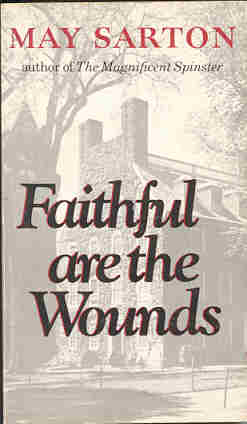
Ideas and Ideals - The Role of the Intellectual Dissenter - Faithful are the Wounds by May Sarton


I have finished May Sarton's Faithful are the Wounds and her writing was even better than I remembered it.

Here's an excerpt:
You must learn to read with the whole of yourselves; you must bring love as well as intellect to this kind of analysis - just as in personal relationships. After all, a really fruitful reading of an author of this stature means giving up yourself for a time, mean being able to encompass something wholly by imaginative sympathy. These are not mere intellectual matters." His fist was closed, as if he were restraining himself from bringing it down with a bang on the table. "You're going at a fine piece of pottery with a blacksmith's hammer. Naturally it breaks to pieces...

And my complete thoughts are here. Her outmodedness is undeserved!