Showing posts with label excerpts. Show all posts

Tuesday, November 27, 2007

The Great Fortune by Olivia Manning


The Great Fortune is the first in Olivia Manning’s Balkan Trilogy. It tells the story of Guy and Harriet Pringle’s marriage set against the background of Bucharest during the ‘Phoney War’ period of 1939/40. Guy teaches in the English Department of the University and Harriet has to find her place in Guy’s friends’ and colleagues’ university circles in the multicultural city. England and Germany are already at war and tensions are high, as the Rumanians fear a German invasion.

Throughout the novel there are contrasts between the rich ruling classes and the peasantry; between life as it was pre-war and the uncertainties and fears that the war is bringing; between the British community in Bucharest and the Rumanians; and between Guy and Harriet as they both adjust to married life, with Harriet making most of the adjustments.

It’s a richly descriptive book of both characters and place. Olivia Manning vividly depicts pre-war Bucharest. In the following scene Guy and Harriet hire a coach to take them out one evening :

“When the trasura stopped at Pavel’s, one of the largest of the open-air restaurants, there could be heard above the traffic the shrill squeak of a gypsy violin. Within the shrub hedge of the garden all was uproar.

The place was crowded. The silver-gilt glow from the globes set in the trees lit in detail the wrinkled tree-trunks, the pebbled ground, and blanched the faces of the dinners, that damp with excitement of food, gazed about them with deranged looks, demanding to be served. Some rapped with knives on wine-glasses, some clapped their hands, some made kissing noises at the waiters, whilst others clutched at every passing coat-tail crying: “Domnule, domnule!” for in this country even the meanest was addressed as ‘lord’.”


Of all the characters Harriet and Prince Yakimov, or as he refers to himself ‘poor old Yaki’, a Russian émigré, half Irish and half White Russian, are the most memorable to me. Harriet is finding it difficult living in a foreign country amongst people she doesn’t know, feeling isolated among strangers, both British and Rumanian, jealous of Guy’s friends and his relationship with Sophie (who had hoped he would marry her) and his allegiance to other people seemingly over his marriage.

Harriet eventually realises that Guy is “a comfortable-looking man of an unharming largeness of body and mind. His size gave her an illusion of security – for it was she was coming to believe, no more than an illusion. He was one of those harbours that prove to be shallow: there was no getting into it. For him, personal relationships were incidental. His fulfilment came from the outside world.”

Yaki, a raconteur and joker, who is said to “have a peculiarly English sense of humour” uses every opportunity to sponge off anyone who will ‘lend’ him money, give him a meal or a bed for the night. He is forever “waiting for m’remittance from m’poor old ma”, promising to repay the loan when it arrives, only to spend it as soon as it does without repaying anyone.

Guy decides to put on a play, Troilus and Cressida, using the students, friends and the “chaps at the Legation” to act the 28 speaking parts. Whilst seeming at first to be over-ambitious and divisive the play is the means of consolidating the Pringles’ relationship and it is a success. However this coincides with fall of Paris and the despondency and fear that this brings. The book ends with the realisation that Rumania will also fall and that the Pringles’ survival depends upon their leaving:

"We’ll get away because we must. The great fortune is life. We must preserve it."

I found the book interesting and informative about the start of the Second World War. It is also an entertaining book working on different levels, exploring the nature of marriage, friendship, patriotism and the attitudes and beliefs of the pre-war period. It’s written in a style that is slightly detached yet energetic and sympathetic. I think I’ll re-read it, as I’m sure there is much that I missed at this first reading. The next book in the trilogy is The Spoilt City. I’ve reserved it at the library and hope it won’t be too long before it arrives.

Tuesday, October 16, 2007

Sons and Lovers by D H Lawrence

I’ve had my second-hand copy of Sons and Lovers sitting unread in a bookcase for several years. The Outmoded Authors Challenge provided the right incentive to read it, one, because I was surprised to find D H Lawrence is considered to be outmoded, two, because I didn’t have to buy or borrow it and three, because it could then come off my to be read list.

When I took off the tatty cover, I discovered that the book inside was not a bit tatty or worn out and as an added bonus it not only contains Sons and Lovers, but also, St Mawr, The Virgin and the Gypsy and The Man Who Died. I’d read The Virgin and the Gypsy a few years ago, but the others were completely new to me.

If you’re planning to read the book, be aware that there are spoilers ahead.

Sons and Lovers is a powerful, emotional novel depicting the struggle, strife, and passion of relationships and their intensity, and possessiveness. Throughout the book Lawrence’s vivid descriptions and observation of the English countryside are so beautiful that I couldn’t stop marvelling at his writing. There are so many examples I could quote. Here is just one:

“The sun was going down. Every open evening, the hills of Derbyshire were blazed over with the red sunset. Mrs Morel watched the sun sink from the glistening sky, leaving a soft flower-blue overhead, while the western space went red, as if all the fire had swum down there, leaving the bell cast flawless blue. The mountain-ash berries across the field stood fierily out from the dark leaves for a moment. A few shocks of corn in a corner of the fallow stood up as if a live; she imagined them bowing; perhaps her son would be a Joseph. In the east, a mirrored sunset floated pink opposite the west’s scarlet. The big haystacks on the hillside, that butted into the glare, went cold.”

The story starts with a description of the cottages in “The Bottoms” where the Morrels live in Nottinghamshire overlooking the hills of Derbyshire. Places feature strongly in the novel and for me provided reality and solidity. Lawrence takes the ordinary and it becomes extraordinary. The family conflict between Walter Morel and his wife and sons is one of the main themes. To Walter, his wife is a “thing of mystery and fascination, a lady” but although at first she thinks he is rather wonderful and noble she soon becomes contemptuous of him and eventually despises him.

Mrs Morel is the dominant character in the Morel family. She is described as a “rather small woman, of delicate mould but resolute bearing”. She is disappointed in her life and her marriage and lives her life through her children and in particular through her three sons – William, Paul and Arthur. William, the oldest leaves home, marries and dies young; Arthur, the youngest, joins the army and also marries; but Paul remains at home and is dominated by his mother and her intense, possessive love for him.

Paul is sensitive, torn between his love for his mother and his feelings for Miriam. Miriam “is very beautiful, with her warm colouring, her gravity, her eyes dilating suddenly like an ecstasy.” Her intensity makes Paul anxious and feel tortured and imprisoned. It is a love/hate relationship. His mother thinks that Miriam will “absorb him till there is nothing left of him, even for himself. He will never be a man on his own feet – she will suck him up.”

This struggle with Paul alternately loving and hating Miriam continues for seven agonising years. Paul cannot break free either from Miriam or from his mother’s suffocating love. Indeed, he realises that his mother is the “pivot and pole of his life, from which he could not escape”. At the same time this is not enough for him and it makes him mad with restlessness. Although Paul cannot finally break off his connection with Miriam, he and Clara, a married woman who is separated from her husband, have a passionate affair. He still feels a desire to be free. His mother sums him up when she says, “Battle – battle – and suffer. It’s about all you do, as far as I can see.”

In parts I found it a harrowing book, in particular the illness and death of Mrs Morel, such a vivid portrayal of Paul’s agony at watching and waiting for his mother’s death. Sons and Lovers is described on the book cover as an autobiographical novel depicting his domination by his mother’s possessiveness. I think that the description of Mrs Morel’s death must also be based on Lawrence’s own experience to a certain extent as well; it is so compellingly real.

There is so much sadness and tragedy and though Paul is lost after his mother’s death he does find hope for the future:

“On every side the immense dark silence seemed pressing him, so tiny a spark, into extinction, and yet, almost nothing, he could not be extinct. Night, in which everything was lost, went reaching out, beyond stars and sun. Stars and sun, a few bright grains, went spinning round for terror, and holding each other in embrace, there in a darkness that outpassed them all, and left them tiny and daunted. So much, and himself, infinitesimal, at the core, a nothingness, and yet not nothing. … But no, he would not give in. Turning sharply, he walked towards the city’s gold phosphorescence. His fists were shut, his mouth set fast. He would not take that direction, to the darkness, to follow her. He walked towards the faintly humming, glowing town, quickly.”

Monday, October 8, 2007

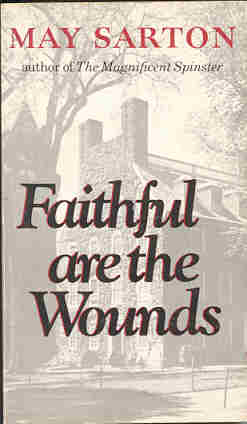
Ideas and Ideals - The Role of the Intellectual Dissenter - Faithful are the Wounds by May Sarton


I have finished May Sarton's Faithful are the Wounds and her writing was even better than I remembered it.

Here's an excerpt:
You must learn to read with the whole of yourselves; you must bring love as well as intellect to this kind of analysis - just as in personal relationships. After all, a really fruitful reading of an author of this stature means giving up yourself for a time, mean being able to encompass something wholly by imaginative sympathy. These are not mere intellectual matters." His fist was closed, as if he were restraining himself from bringing it down with a bang on the table. "You're going at a fine piece of pottery with a blacksmith's hammer. Naturally it breaks to pieces...

And my complete thoughts are here. Her outmodedness is undeserved!

Saturday, September 15, 2007

The Last September by Elizabeth Bowen

I'm about fifty pages into The Last September by Elizabeth Bowen, and so far I'm absolutely loving it! It rather reminds me of an interwar Jane Austen so far, and it also evokes Eudora Welty's Delta Wedding. I think I may have a new favourite author on my hands. :)

The reason I'm posting now is that I just had to share the great preface in my edition (a 1964 Knopf hardcover I bookmooched). She discusses writing the book, and she just seems so graceful and classy. I'd like to share some of her thoughts on writing. While I'm not a writer, these seemed full of insight.
One may perceive that, generally, in the novel the characters are held in the same orbit by some sort of situation which sets, as it were, a trap-some central device, devilmen, search or passion. My own solution, however, was a more childish one: again in The Last September, as in The Hotel, I used the device of grouping my men and women actually under the same roof, and of keeping them thus located, whether by choice or chance, for such time as the story should need to run its course. The Italian resort hotel of my first venture was, for the second, replaced by the Irish country house. I recognise that I am, and was bound to be, a writer intensely subject to scence and time: both do more than figure, they play their parts in my plots. The approaching close of the visitors' winter season adds edge to the little drama of The Hotel. The Last September, even more, takes its pitch from that lovely, too mortal month which gives the novel its name.

The writer is like the swimmer caught by an undertow; he is borne by it back to those scenes of his own life most steeped in subjective experience which he did not know of. Sensation accumulates where it is least sought; meaning flows in, retrospectively, where we were blind to any. One is captured by the mysterious, the imperious hauntedness of a pariod not understood in its own time.

I was very much struck by her observations on being young. I turned twenty-one in April, and I feel as if she put her finger on where I am right now. It's reassuring to know that I'm not the only one!
In "real" life, my early girhood in the County Cork, in the house which is the "Danielstown" of the story was, though accented from time to time by aspiration, passing romance or pleasure, mainly a period of impatience, frivolity, lassitude or boredome. I endlessly asked myself what I should be, and when? The young (who are, ironically, so much envied) do all, I suspect, face those patches of barren worry.

When one is young, years are longer; each one one has lived seems dynamic and fraught with a conquest. In most lives (and mine conformed to the shape) the years between twnety and twenty-eight are often important, decisive ones.

Sunday, September 2, 2007

Letters from a prisoner by James Blake

Ever since I started this challenge some of the selected authors have been popping out at me. Elizabeth Bowen was apparently a friend with Ivy Compton-Burnett and I spied a J.B. Priestly book (a nominee who didn't quite make the cut) on a used book store's shelf. James Blake mentioned Bowen and a more popular author, D.H. Lawrence, in two out of series of letters published in the 13th issue of the Paris Review in 1956. I've posted excerpts of each below.

"...James Blake, a night club pianist by profession, was a convict in a southern county jail. The Mr. X to whom a number of the letters are addressed is a well-known American author."

DEC.9, 1951
Dear X:
This week I finished a book that Jack O. sent me, Elizabeth Bowen's Heat of the Day, and for a couple of days, impressionable ass that I am, I was clipped in my speech and moodily English. That kind of performance needs a discerning audience, though, and if my colleagues noticed it at all, it was to give me a brief, dimly suspicious glance and dismiss the matter, the way a cow does when she looks at you.

--My work out on the road has brought me into contact with quite a number of cows lately, and I've never seen anything to beat the way they can convey quiet contempt. It may be that one brief glance tells them I'm not a bull and therefore beneath notice -- Still, you can't tell. A number of the funloving lads on the gang give vivid and explicit accounts of illicit relations with cows, and it may be that the harrassed and confused animals have put down the whole human race as warped, or inconstant, or at the very least impotent... I think I shall leave all that to the admirable Kinsey.

Thank you ever so much for the deuce and the stamps and postcards. I was able to get a haircut, buy some tobacco and writing paper, and some food that wasn't drowning in glutinous gravy. Our cook is a con who was a merchant mariner and he seems to believe that if it ain't afloat it ain't digestible. As a result, I am awash most of the time.

I have the published versions of four plays I'd like to send you, if you care to send me about forty cents in stamps, and if you're interested. Not hawking anything, I just would like to reciprocate in any way I can. They are Rose Tattoo, King and I, Moon is Blue and Gioconda Smile. If you don't read plays yourself, you might know someone who does.

JAN. 13, 1952
Dear X.:
Of the books you sent, I've enjoyed re-reading Huck Finn very much and D.H. Lawrence's hotsy-totsty opus The Lost Girl, new to me. Some rather shrewd and delightful humor in this Lawrence book, though, something I've encountered in his other things.

One thing I have noticed about Lawrence, though (said the mountain, proudly bringing forth a mouse). I ran across Lady Chatterly not long ago and re-read it. To my intense disappointment, most of the "hot parts" were deleted, and it was spangled with asterisks -- but in both books, it seemed to me that his descriptions of scenes of passion, or bedroom bouts, were almost womanishly fervent. That is, the viewpoint seemed to be female. Curious.

However, maybe it is all "in the eye of the beholder", and instead of being penetrating, I am merely tipping my mitt. The hell with it.