Showing posts with label May Sarton. Show all posts

Monday, December 3, 2007

Journal of a Solitude - May Sarton

Journal of a Solitude is a deeply personal book. It chronicles a year in the life of the poet at age 58. Her solitary journaling takes place at her family home, Nelson, in New Hampshire. She hopes, with this journal to;
...break through into the rough, rocky depths, to the matrix itself. There is violence there and anger never resolved. My need to be alone is balanced against my fear of what will happen when suddenly I enter the huge empty silence if I cannot find support there.
Sarton writes a level beyond simplistic themes of desire and choice, exploring her internal struggles from a plainly humanistic viewpoint.

I wonder when and why May Sarton was kicked out of the "in crowd"? She's been on my radar since the tender age of eighteen. She's even quoted in my Intermediate Algebra book! Page 1, no less!:

"I see a certain order in the universe[,] and math is one way of making it visible." - May Sarton, As We Are Now, 1973 ; )


In Wikipedia's page on the life and writings of May Sarton, it is stated that "many of her novels and poems are pellucid reflections of the lesbian experience."

Pellucid:
1 : admitting maximum passage of light without diffusion or distortion pellucid stream
2 : reflecting light evenly from all surfaces
3 : easy to understand


Sarton strikes me as a lover of many things, flowers, friends, poetry, nature, light. She actively loves the ever changing and the intangible. Her loves truly do seem to diffuse without distortion...there is a purity in her self acceptance that results in stark honesty and a deeply ingrained integrity.

I recall reading, at age eighteen, her images of love; the expectations and concurrent frustrations, and taking them at face value. That hasn't changed, twenty years later. She does not appear to have much of a reservoir of hate. Her problematic anger (Sarton confesses to fits of rage) seems to be based upon her frustrations within the moment. She is forgiving, of others and of herself, with a loving perspective by nature. Sarton is grounded in the moment, completely.

I find myself hesitant to pigeonhole Sarton in any way. I read Journal of a Solitude for the first time at the afore mentioned tender age of eighteen and at that time (I am a little embarrassed to admit) I didn't overtly perceive that Sarton was gay. I realize that sounds strange. As I reread the book now, I see that Sarton addresses the issue quite obviously. I believe the lack of perception on my part came from being young, and being raised in a culture where homosexual rights have always been a hot topic.

She is an activist in the purest sense. In Journal of a Solitude her activism spreads in many directions; she addresses a range of issues from homosexuality to marriage to women's rights to the state of government during that time.

She opines about De Gaulle, upon his death; "Wholeness, so far as statesmen go, may have something to do with speaking in one's own words. De Gaulle did not call in "writers"; the very idea is grotesque. The leader who allows others to speak for him is abdicating. Who is speaking via Nixon? Who wrote this phrase or that? One is never quite sure. He and Agnew became puppets. Who is the ventriloquist who manipulates them?"

Once again; WHY was she kicked out of the in crowd?

Sarton isn't afraid to think or question. Ultimately she isn't afraid to take her thoughts to the highest level she is capable of, regardless of personal discomfort. She isn't afraid to speak her mind. I'm keeping this book next to the bedside for a long while.

Monday, November 5, 2007

Second Book Up!

I read May Sarton's The Small Room a little bit ago, and now I've posted my thoughts up on my blog. Let me just say that I found her a very powerful writer! It's awesome: so far, I've found two incredible women authors through this challenge. I used to always read more men than women; this is helping to balance that out!

I'm not sure what I'll read this month: I still have some Walter Scott, G.K. Chesterton, and Sarah Orne Jewett on my list. I guess it'll depend on what mood I'm in. :)

Sunday, November 4, 2007

#3 The Small Room - May Sarton

"It’s just that I feel overwhelmed. I don’t see how anyone can be a good teacher, let alone a great one. You can’t win; either you care too much or too little; you’re too impersonal or too personal; you don’t know enough or you bury the students in minutiae; you try to teach them to write an honest sentence, and then discover that what is involved is breaking a psychological block that can only be broken if you take on the role of psychoanalyst…" –Lucy Winter in The Small Room

The Small Room is a deeply questioning novel about women and the unique relationship between teacher and pupils. Set in a New England college for girls, the book explores how inveterate, established traditions and values of teaching are being challenged as demanded by the ever changing student body over time. Prizing excellence, the college presumes that by setting an uncompromising standard it might develop women who can take the lead, who can become responsible in the deepest sense.

The synonym to academic prestige is the invincible Professor Carryl Cope, a distinguished scholar, inspiring teacher who has been stimulating to her students. Despite her dominating over the faculty, she has adopted her students like orphans, push them, wrangle with them, and force them to grow in academic excellence. Her brilliance, dedication and strengths seem so flawless and formidable until a favorite student of hers, a rising star, fails to cope with the pressure to achieve higher ground, perpetrates an unethical act that threatens to shatter the very tradition of excellence.

Ranged against Carryl Cope is Lucy Winter, a fresh arrival to the school who lives on the heels of a disastrous relationship. Until the outburst of the scandal, Lucy has doubt and feels misgiving about involving with students at a personal level. That she has been haunted by personal affair makes her seek convalescence in this safe world in a college. But this temporary refuge turns out to be one that is reeled with tension, as immense amount of loose hostility and anger unveil and float around against Carryl Cope, who tries to hush up the student’s scandal.

Lucy Winter, who holds the students as individuals, snaps out of her teaching personality in the classroom, is able to answer students’ pleas for personal attention. What she gives to them is exactly the bane to Cope’s fall–for Cope has failed to penetrate to students’ personal lives and problems. In molding and pruning the students, Lucy has taught a most valuable lesson. “It’s not about winning.” Indeed, one can prove to be above the critic but if one doesn’t have self-respect and love, life has no meaning. This is a sentimental education that transcends scholastic merits. It’s about teaching students how to feel, how to live, and how to experience–the means to help ripen in life.

The Small Room is an absorbing work that probes into the most ambivalent and delicate quarters of human heart. It delves into the seemingly calm world of academia in which the faculty, beset by their conscience, are forced to reappraise their profession and motives.

Monday, October 8, 2007

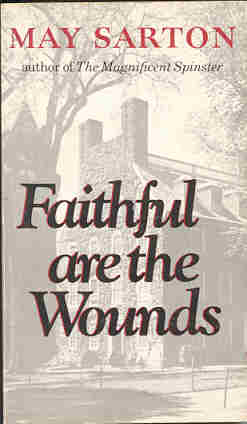
Ideas and Ideals - The Role of the Intellectual Dissenter - Faithful are the Wounds by May Sarton


I have finished May Sarton's Faithful are the Wounds and her writing was even better than I remembered it.

Here's an excerpt:
You must learn to read with the whole of yourselves; you must bring love as well as intellect to this kind of analysis - just as in personal relationships. After all, a really fruitful reading of an author of this stature means giving up yourself for a time, mean being able to encompass something wholly by imaginative sympathy. These are not mere intellectual matters." His fist was closed, as if he were restraining himself from bringing it down with a bang on the table. "You're going at a fine piece of pottery with a blacksmith's hammer. Naturally it breaks to pieces...

And my complete thoughts are here. Her outmodedness is undeserved!