I have really enjoyed the Outmoded Authors Challenge. I have read books that I wouldn't have read otherwise and have learnt about others from the reviews by other people. Thanks to Imani, who hosted this challenge.
My initial list is here.
I read:
Ivanhoe by Sir Walter Scott. I'd never read anything by Scott before and had an idea that his books would be difficult to read. I didn't find Ivanhoe difficult at all and enjoyed reading it. My thoughts on this book are here.
The Moon and Sixpence by W Somerset Maugham, another author whose work I'd never read before. I wrote about this here.
The Balkan Trilogy by Olivia Manning. I know nothing about Manning's books. I only managed to read two books in the trilogy - The Great Fortune and The Spoilt City. Friends and Heroes, the third book was listed in the library catalogue but when I tried to borrow it I found that it was no longer available because the branch library which holds it had been closed due to the library cost-saving cuts. I've been listening on Radio 4 to the trilogy so I now know what happens in Friends and Heroes, but I will read the book as soon as I can get a copy.
Sons and Lovers by D H Lawrence. I had previously read Women in Love and The Virgin and the Gypsy, but not Sons and Lovers. I loved it - see here. I also read The Man Who Died - see here.
The only book I started and didn't finish was As a Man Grows Older by Italo Svevo. I knew nothing about this author. The library has a copy of this book which I borrowed. I don't often abandon a book but soon after I started to read it I thought it was tedious and I took it back unread. I did read the Introduction after I'd decided not to read the book and was dismayed when I read that he had been encouraged by James Joyce in his writing. I think I'd like to read Ulysses sometime, but if it's anything like Svevo's book that will be another book I'll abandon.
I'm looking forward to joining in again when the second challenge starts later this year.
Showing posts with label Olivia Manning. Show all posts
Showing posts with label Olivia Manning. Show all posts
Sunday, March 2, 2008


Sunday, February 10, 2008
Olivia Manning - The Balkan Trilogy
I have just discovered that The Balkan Trilogy is being broadcast on BBC Radio 4 as Fortunes of War. Today was the third in a series of three programmes, two programmes allotted to each book in the trilogy. It seems that Olivia Manning is no longer an outmoded author. The dramatisation is good, with Joanna Lumley taking the part of Harriet, looking back on events and Honeysuckle Weeks as young Harriet. Both are just right for the part.
I’ve read the first two books The Great Fortune and The Spoilt City, but not yet read the third book Friends and Heroes. I am waiting for it to be delivered, so in the meantime this is just perfect. I’ll be able to listen to it in the next two episodes before I get to the book.
I’ve read the first two books The Great Fortune and The Spoilt City, but not yet read the third book Friends and Heroes. I am waiting for it to be delivered, so in the meantime this is just perfect. I’ll be able to listen to it in the next two episodes before I get to the book.
Monday, January 7, 2008
The Spoilt City by Olivia Manning

The Spoilt City was first published in 1962, published by Arrow Books in 2004. 295 pages.
It is the second in Olivia Manning’s Balkan Trilogy. (I wrote about the first book The Great Fortune here.) It continues the story of Guy and Harriet Pringle’s life in Bucharest during 1940. The ‘Phoney War’ is now over and the invasion by the Germans is ominously threatened causing much unrest and uncertainty.
Harriet and Guy’s ideas clash; with Harriet longing to return to England and Guy determined to stay in Bucharest. The difference in their characters is also developed. Harriet is more critical of people than Guy, who prefers to like people, knowing this is the basis of his influence over them. Her criticism troubles him, but he recognises that she is stronger than him in some ways and he is influenced by her. Harriet takes a more general view than Guy and has “rejected the faith which gave his own life purpose.”
Guy is however, pragmatic and sees religion as “part of the conspiracy to keep the rich powerful and the poor docile”. He is not interested in “fantasy” but in “practical improvement in mankind’s condition." Harriet is not so practical, but she comes to appreciate that Guy is right: “Wonders were born of ignorance and superstition. Do away with ignorance and superstition and there would be no more wonders, only a universe of unresponsive matter in which Guy was at home, though she was not. Even if she could not accept this diminution of her horizon, she had to feel a bleak appreciation of Guy, who was often proved right.”
Guy’s generosity to everyone frustrates Harriet in her attempts to survive and indeed to leave the country. They are ordered to leave but he persists in staying put as the escape routes were being blocked. As Guy argues the case for staying “ … we represent all that is left of western culture and democratic ideas”, Harriet begins to think that even though they have only been married for one year that the bonds between them are loosening.
Once again Yakimov comes to the fore, providing some comic relief. He is one of the people that Guy tries to help. He visits Von Flugel, a Nazi and an old friend in Cluj. Von Flugel thinks Yaki is a British spy, but even so he gives him 25,000 lei to return to Bucharest to buy an Ottoman rug for him. When he gets to Bucharest he finds everything has changed for the worse, the army has been called out and an attack on the palace is expected. He quickly packs up and leaves on the Orient Express for Istanbul using the money from Von Flugel.
As the blitz on London begins Harriet increases her efforts to leave the country but Guy still wants to stay. They go for a short “holiday” in Predeal in the mountains and Harriet becomes increasingly critical of Guy and feels bored in his company. As both their relationship and the situation in Rumania deteriorate Guy persuades Harriet to leave without him after their flat is raided and ransacked.
This is a bleak story and as I was reading it I thought it was not as good as the first book in the trilogy, The Great Fortune, but thinking about it now, that maybe because it is set in such an adverse situation set against the backdrop of war. I became increasingly critical of Guy and impatient for him to agree with Harriet. Perhaps that is the measure by which I should consider the book – it certainly seemed real to me and conveyed the tension and fears of living in Rumania at that time as well as chronicling the Pringles’ marriage. As with The Great Fortune there is a great deal of information about the political situation, which was new to me and at times I did find that difficult to follow, which didn’t help with my enjoyment of the book. What I did enjoy was the character development and their realtionships. I also enjoyed Olivia Manning's descriptive writing eg:
"The air was furred with heat. On the pavement the Guardist youths with their banners and pamphlets, were still trying to rouse revolt. Although a sense of revolt agitated the nerves like an electric storm that would not break, the city was lethargic, the palace dormant, its white blinds drawn down against the tedium of the afternoon. ... The height of summer was past. The dahlias were ablaze in the Cismigiu. Up the Chaussee, the trees were parched, their few leaves dangling like burnt paper, as they had been the first time she saw them. The brilliant months had gone down in fear and expectation of departure."
The story is continued in Friends and Heroes, the third book in the trilogy. The Outmoded Authors Challenge finishes at the end of this month and it's not looking as though I'll read the third book before then, but I will definitely read it before long.
Monday, December 24, 2007
The Balkan Trilogy - Olivia Manning
I have finished Olivia Manning's The Balkan Trilogy. Manning writes insightfully about her characters and the story put me convincingly in the experience of an expat in Europe at the start of World War II. The Pringles marry and move to Bulgaria, as Guy Pringle teaches English there for the English Legation -they are forced to leave Bucharest as the Nazis encroach on Eastern Europe. They escape to Athens, where they are only steps ahead of the Germans and by the end of the third volume, they are again fleeing, this time for the Middle East where Manning's next trilogy is set - The Levant Trilogy. The story is held together not only by history and politics, although those are An important part of it, but by the growth of the relationship of the Pringles. Harriet Pringle is very different from Guy, and she thrown into a marriage with a man she has known only a few weeks and immediately moves to a new country where she doesn't speak the language or know anyone besides her new husband. The story is as much one of Harriet's growing insight about herself as it is our experience of the war through naive eyes.
Reading the trilogy has made me interested in getting to know more of Manning's books - she is a descriptive and un-showy writer with human and historical insight and I found the events of these three novels almost mesmerizing. Reading them for two or three hours at a stretch never seemed an effort. If you haven't read anything by her, and I hadn't before these - I recommend her heartily. You can find my other posts about the trilogy here.
Reading the trilogy has made me interested in getting to know more of Manning's books - she is a descriptive and un-showy writer with human and historical insight and I found the events of these three novels almost mesmerizing. Reading them for two or three hours at a stretch never seemed an effort. If you haven't read anything by her, and I hadn't before these - I recommend her heartily. You can find my other posts about the trilogy here.
Thursday, December 20, 2007
Olivia Manning - The Spoilt City
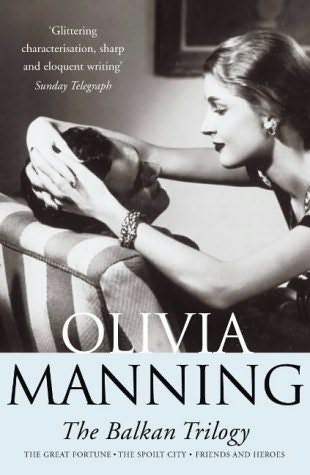
Olivia Manning's The Balkan Trilogy is such a vivid account of what it must have been like, I imagine, to be an ex-pat during the beginning of World War II. Manning is particularly insightful about her characters. I enjoy watching the young couple, the Pringles, getting to know each other better through their travails and the political events are very excitingly drawn. See my full thoughts here.
Tuesday, December 18, 2007
History Re-Lived (The Great Fortune by Olivia Manning)
What was most impressive in The Great Fortune, the first of the three books in The Balkan Trilogy, is how Olivia Manning creates a story of suspense out of historical events to which we already know the ending. Set at the start of World War II as a newly wed English couple comes to Roumania, the story is -necessarily - the war. What will the Axis do? Will the allegiance with Russia last? Will they be able to return to England? Will the English protect Roumania as they had promised? Will the Nazi's invade France? We actually know the answers to these questions, but I care about the outcome because this story is really about the lives of a broad cast of warmly observed people and how their existence is affected by the world's events. Read my full thoughts here.
Monday, December 3, 2007
Arriving in Bucharest on the Eve of War (The Balkan Trilogy by Olivia Manning)
Oddly enough, I too am reading The Balkan Trilogy by Olivia Manning. Manning's ability to present the sweep of a scene in which many small dramas seem to be happening at once, and to people those dramas with detailed characters, is remarkable. In just twenty-five pages I am already swept up in the hysterical atmosphere of war. My full post is here.
Tuesday, November 27, 2007
The Great Fortune by Olivia Manning

The Great Fortune is the first in Olivia Manning’s Balkan Trilogy. It tells the story of Guy and Harriet Pringle’s marriage set against the background of Bucharest during the ‘Phoney War’ period of 1939/40. Guy teaches in the English Department of the University and Harriet has to find her place in Guy’s friends’ and colleagues’ university circles in the multicultural city. England and Germany are already at war and tensions are high, as the Rumanians fear a German invasion.
Throughout the novel there are contrasts between the rich ruling classes and the peasantry; between life as it was pre-war and the uncertainties and fears that the war is bringing; between the British community in Bucharest and the Rumanians; and between Guy and Harriet as they both adjust to married life, with Harriet making most of the adjustments.
It’s a richly descriptive book of both characters and place. Olivia Manning vividly depicts pre-war Bucharest. In the following scene Guy and Harriet hire a coach to take them out one evening :
“When the trasura stopped at Pavel’s, one of the largest of the open-air restaurants, there could be heard above the traffic the shrill squeak of a gypsy violin. Within the shrub hedge of the garden all was uproar.
The place was crowded. The silver-gilt glow from the globes set in the trees lit in detail the wrinkled tree-trunks, the pebbled ground, and blanched the faces of the dinners, that damp with excitement of food, gazed about them with deranged looks, demanding to be served. Some rapped with knives on wine-glasses, some clapped their hands, some made kissing noises at the waiters, whilst others clutched at every passing coat-tail crying: “Domnule, domnule!” for in this country even the meanest was addressed as ‘lord’.”
Of all the characters Harriet and Prince Yakimov, or as he refers to himself ‘poor old Yaki’, a Russian émigré, half Irish and half White Russian, are the most memorable to me. Harriet is finding it difficult living in a foreign country amongst people she doesn’t know, feeling isolated among strangers, both British and Rumanian, jealous of Guy’s friends and his relationship with Sophie (who had hoped he would marry her) and his allegiance to other people seemingly over his marriage.
Harriet eventually realises that Guy is “a comfortable-looking man of an unharming largeness of body and mind. His size gave her an illusion of security – for it was she was coming to believe, no more than an illusion. He was one of those harbours that prove to be shallow: there was no getting into it. For him, personal relationships were incidental. His fulfilment came from the outside world.”
Yaki, a raconteur and joker, who is said to “have a peculiarly English sense of humour” uses every opportunity to sponge off anyone who will ‘lend’ him money, give him a meal or a bed for the night. He is forever “waiting for m’remittance from m’poor old ma”, promising to repay the loan when it arrives, only to spend it as soon as it does without repaying anyone.
Guy decides to put on a play, Troilus and Cressida, using the students, friends and the “chaps at the Legation” to act the 28 speaking parts. Whilst seeming at first to be over-ambitious and divisive the play is the means of consolidating the Pringles’ relationship and it is a success. However this coincides with fall of Paris and the despondency and fear that this brings. The book ends with the realisation that Rumania will also fall and that the Pringles’ survival depends upon their leaving:
"We’ll get away because we must. The great fortune is life. We must preserve it."
I found the book interesting and informative about the start of the Second World War. It is also an entertaining book working on different levels, exploring the nature of marriage, friendship, patriotism and the attitudes and beliefs of the pre-war period. It’s written in a style that is slightly detached yet energetic and sympathetic. I think I’ll re-read it, as I’m sure there is much that I missed at this first reading. The next book in the trilogy is The Spoilt City. I’ve reserved it at the library and hope it won’t be too long before it arrives.
Throughout the novel there are contrasts between the rich ruling classes and the peasantry; between life as it was pre-war and the uncertainties and fears that the war is bringing; between the British community in Bucharest and the Rumanians; and between Guy and Harriet as they both adjust to married life, with Harriet making most of the adjustments.
It’s a richly descriptive book of both characters and place. Olivia Manning vividly depicts pre-war Bucharest. In the following scene Guy and Harriet hire a coach to take them out one evening :
“When the trasura stopped at Pavel’s, one of the largest of the open-air restaurants, there could be heard above the traffic the shrill squeak of a gypsy violin. Within the shrub hedge of the garden all was uproar.
The place was crowded. The silver-gilt glow from the globes set in the trees lit in detail the wrinkled tree-trunks, the pebbled ground, and blanched the faces of the dinners, that damp with excitement of food, gazed about them with deranged looks, demanding to be served. Some rapped with knives on wine-glasses, some clapped their hands, some made kissing noises at the waiters, whilst others clutched at every passing coat-tail crying: “Domnule, domnule!” for in this country even the meanest was addressed as ‘lord’.”
Of all the characters Harriet and Prince Yakimov, or as he refers to himself ‘poor old Yaki’, a Russian émigré, half Irish and half White Russian, are the most memorable to me. Harriet is finding it difficult living in a foreign country amongst people she doesn’t know, feeling isolated among strangers, both British and Rumanian, jealous of Guy’s friends and his relationship with Sophie (who had hoped he would marry her) and his allegiance to other people seemingly over his marriage.
Harriet eventually realises that Guy is “a comfortable-looking man of an unharming largeness of body and mind. His size gave her an illusion of security – for it was she was coming to believe, no more than an illusion. He was one of those harbours that prove to be shallow: there was no getting into it. For him, personal relationships were incidental. His fulfilment came from the outside world.”
Yaki, a raconteur and joker, who is said to “have a peculiarly English sense of humour” uses every opportunity to sponge off anyone who will ‘lend’ him money, give him a meal or a bed for the night. He is forever “waiting for m’remittance from m’poor old ma”, promising to repay the loan when it arrives, only to spend it as soon as it does without repaying anyone.
Guy decides to put on a play, Troilus and Cressida, using the students, friends and the “chaps at the Legation” to act the 28 speaking parts. Whilst seeming at first to be over-ambitious and divisive the play is the means of consolidating the Pringles’ relationship and it is a success. However this coincides with fall of Paris and the despondency and fear that this brings. The book ends with the realisation that Rumania will also fall and that the Pringles’ survival depends upon their leaving:
"We’ll get away because we must. The great fortune is life. We must preserve it."
I found the book interesting and informative about the start of the Second World War. It is also an entertaining book working on different levels, exploring the nature of marriage, friendship, patriotism and the attitudes and beliefs of the pre-war period. It’s written in a style that is slightly detached yet energetic and sympathetic. I think I’ll re-read it, as I’m sure there is much that I missed at this first reading. The next book in the trilogy is The Spoilt City. I’ve reserved it at the library and hope it won’t be too long before it arrives.
Subscribe to:
Posts (Atom)

